Dealer · Product-design decision
Routine defaults, with a path for exceptions
Use familiar product ranges for everyday quoting while keeping supplier assessment available when the configuration needs expert judgement.
Project context: Web quoting and configuration for window and door dealers. The wider product covered 200+ screens across dealer, supplier, support and licensing interfaces, alongside reports and emails.
My contribution: I adapted established V6 workflows for web use and dealers who were not configuration experts.
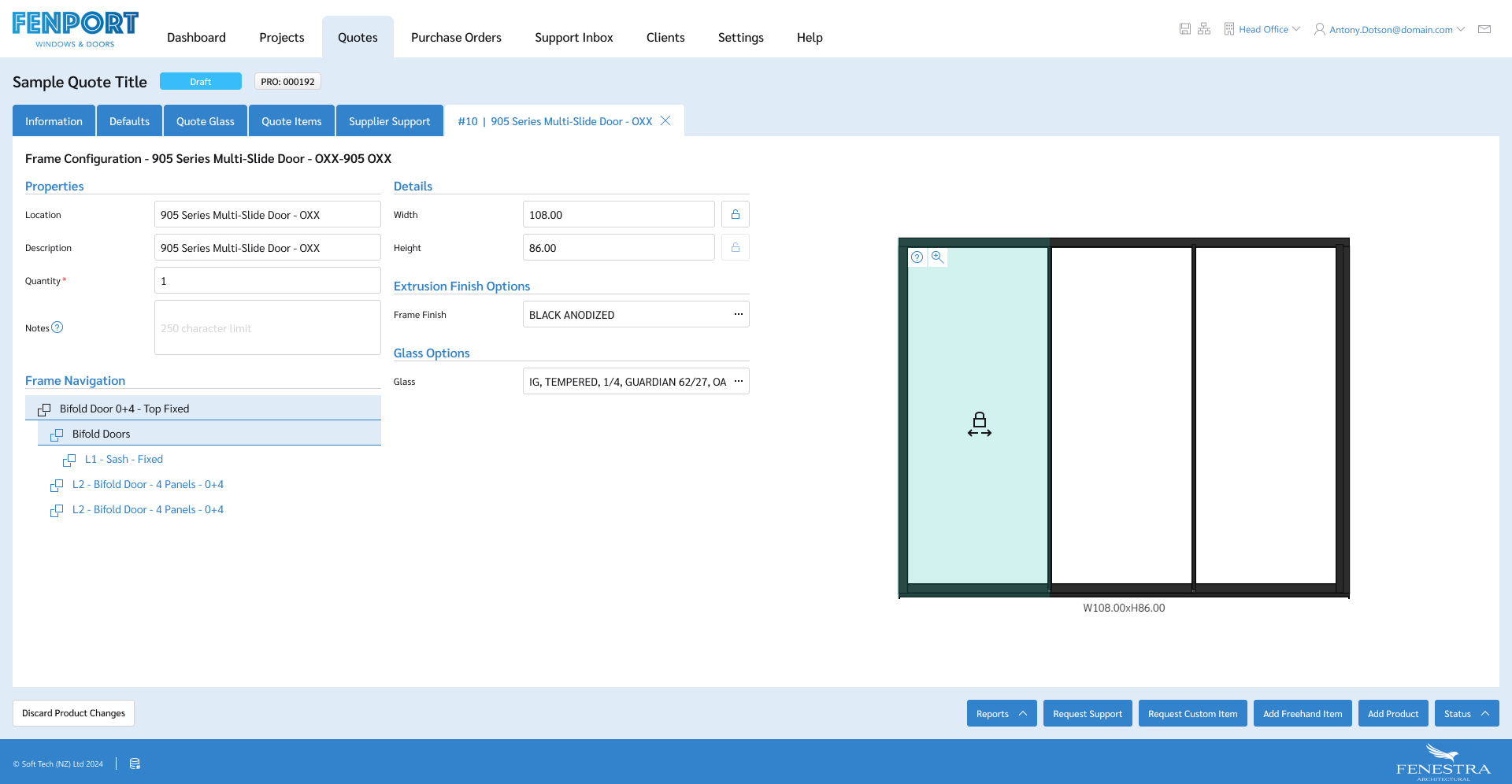
Many smaller dealers work with a limited range of extrusions, glass and colours. We used predefined options so routine quoting could focus mainly on dimensions and the relevant sash choices.
Defaults were one layer, not the whole answer
Some options can conflict, supplier validity can expire, and different users have different expertise. Defaults help avoid validation issues with standard products. More customised work has two exception paths: allowed validation errors and critical errors.
- Deliberate choice
- Use defaults for routine products, allow selected validation errors to proceed to a PO and supplier assessment, and block the PO for critical errors.
- Boundary
- Allowed validation errors can proceed to a PO and supplier assessment of whether the product is doable or needs changes. Critical errors block the PO until the supplier resolves the issue and the dealer reviews the returned quote.
- Accepted trade-off
- Both exception paths need supplier involvement. Critical cases require a ticket, supplier resolution and a dealer check before a PO can be issued.
A route to expert judgement
The work balances a simpler everyday flow with the complexity that sometimes needs expert review.
Reduced errors and faster quoting are not quantified. The export does not demonstrate every validation or support state.
With allowed validation errors, a purchase order can be issued. The supplier still needs to assess whether the product is doable or change it so it is valid.
Critical errors prevent a purchase order from being issued. The dealer usually raises a ticket for the supplier to check the quote or product, fix the issues or reject it. Once resolved, the quote returns to the dealer to double-check and issue the purchase order.
Supplier support could operate in the dealer context and fix a quote on the dealer's behalf. Differentiating regular and power-user options, revalidation and supplier assistance formed part of the wider approach.
 Inspect image and full context
Boundaries and evidence
The export shows product controls, component navigation, options and a drawing. The exception-handling sequence above comes from my account; this image does not depict every allowed-error, critical-error, ticket or supplier-return state. Exact default inheritance, lock behaviour and validation timing are not inferred from the image. Faster quoting and fewer errors remain intended benefits unless supported by the relevant evidence; no numerical result is claimed here.