Jobio · Product-design decision
Evolving a shared interaction system as the product grew
Moving from early UI standardisation through a phased component migration and the guidance needed to keep later work consistent.
Project context: An AI-powered application workspace for understanding roles, preparing documents and tracking a job search. The work spans the application, marketing website, payment model and practical service delivery.
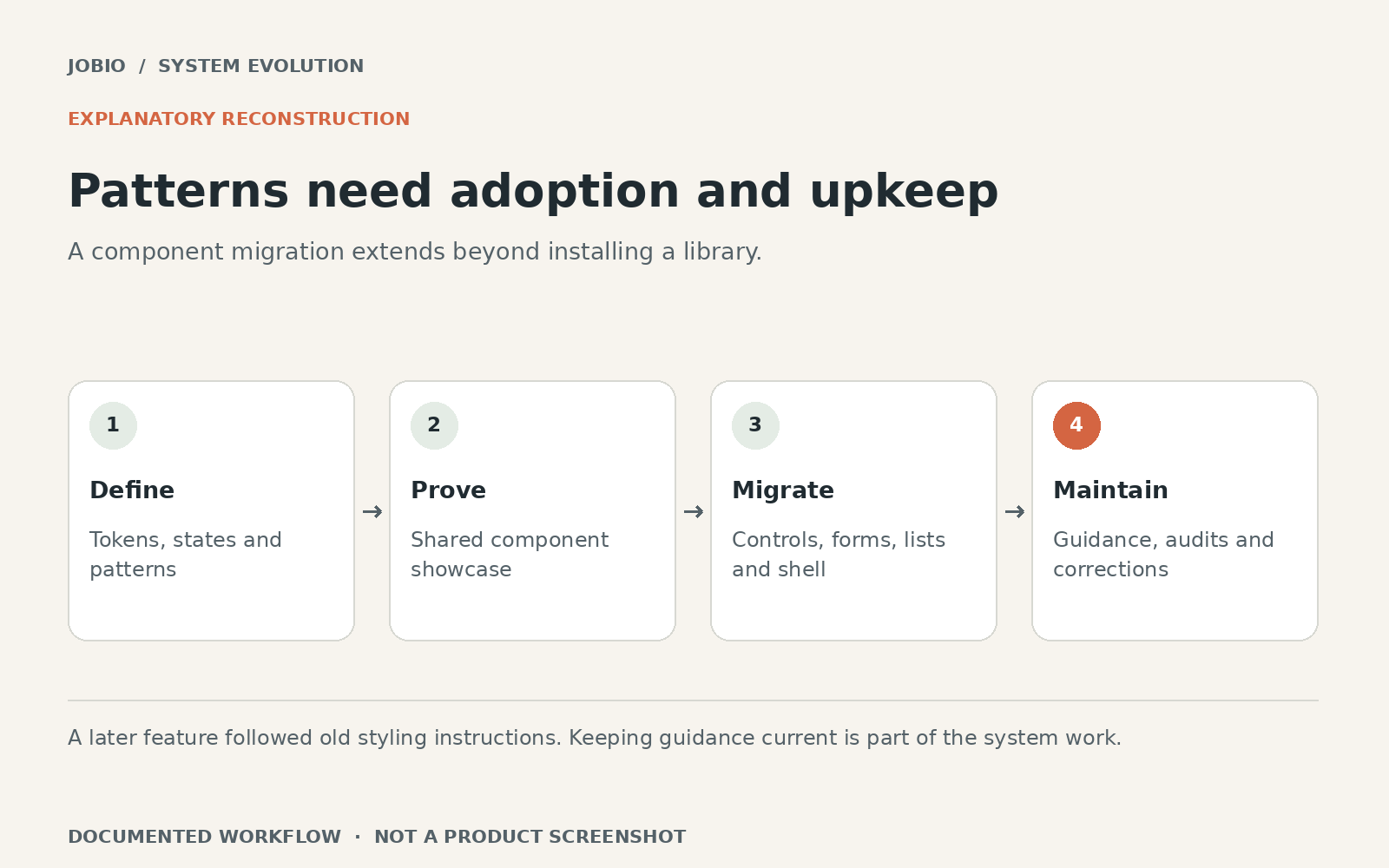
My contribution: Define shared tokens, component patterns and a development showcase. Migrate common controls and whole workflows in phases. Maintain component guidance and correct later use of stale styling instructions.
Jobio did not start without a UI system. Early work standardised the interface with DaisyUI. As the product grew, limitations appeared around customised controls, duplicated desktop/mobile structures, overlays, forms and feedback.
Starting from product behaviour
The migration was useful because it addressed those interactions, rather than because a different component library existed. I established shared tokens and patterns, used a development showcase to make them inspectable and documented how the product should apply them.
The work then moved through common controls, forms, responsive lists, navigation and panels, confirmations and feedback. A phased approach let existing workflows continue while shared behaviour changed. Compatibility bridges were part of that transition rather than evidence of a perfectly clean replacement from the first step.
- Alternative considered
Keep patching each screen independently or make one undifferentiated full rewrite. Independent fixes retained duplication; a full replacement increased the amount of behaviour changing at the same time.
- Deliberate choice
- Establish patterns and guidance, then migrate primitives, forms, lists and shell behaviour in stages.
- Accepted trade-off
- Compatibility bridges and migration documentation are additional work, and later features can still regress if they follow stale instructions.
Making the system usable for subsequent work
Component references and migration guidance captured which primitives to use, how to handle states and how layouts should respond. That matters especially in an AI-assisted build: the instructions that shape new implementation are themselves part of the product's consistency mechanism.
A later CV feature exposed this dependency when stale DaisyUI guidance reappeared. Correcting the feature also meant correcting the instructions that could reproduce the problem. The system needed maintenance after the migration, not only a completed checklist at its end.
 Inspect image and full context
What the work establishes
Jobio gained shared component and interaction patterns across controls, forms, responsive lists, overlays and feedback, backed by migration and component guidance.
This is an independent-product system and adoption effort. It is not a company-wide programme, a verified accessibility-conformance result or a measured performance improvement.
My responsibility combined interaction design, pattern definition, documentation and AI-assisted implementation. The evidence is the phased migration, resulting shared components and the later correction loop. It demonstrates a practical system within one independent product.
Audit records still left manual checks open, and historical bundle/performance figures used inconsistent baselines. I therefore do not use them to claim accessibility compliance or a numerical performance gain. The reusable behaviour and the work required to sustain it are the substance of this story.