Jobio · Product-design decision
Supporting momentum without automating pressure
Choosing explainable inactivity signals and consent-based reminders over paid, generated follow-up outreach.
Project context: An AI-powered application workspace for understanding roles, preparing documents and tracking a job search. The work spans the application, marketing website, payment model and practical service delivery.
My contribution: Explore momentum hypotheses and narrow the delivered engagement approach. Replace the paid generated follow-up concept with explainable Gone Quiet detection. Design distinct digests, interview reminders and lifecycle nudges with consent and preference controls.
The early Jobio strategy explored the emotional as well as practical difficulty of a job search: silence, loss of momentum and uncertainty about what to do next. Those were product hypotheses that generated several possible solutions, including follow-up generation and gamification.
Narrowing the response to silence
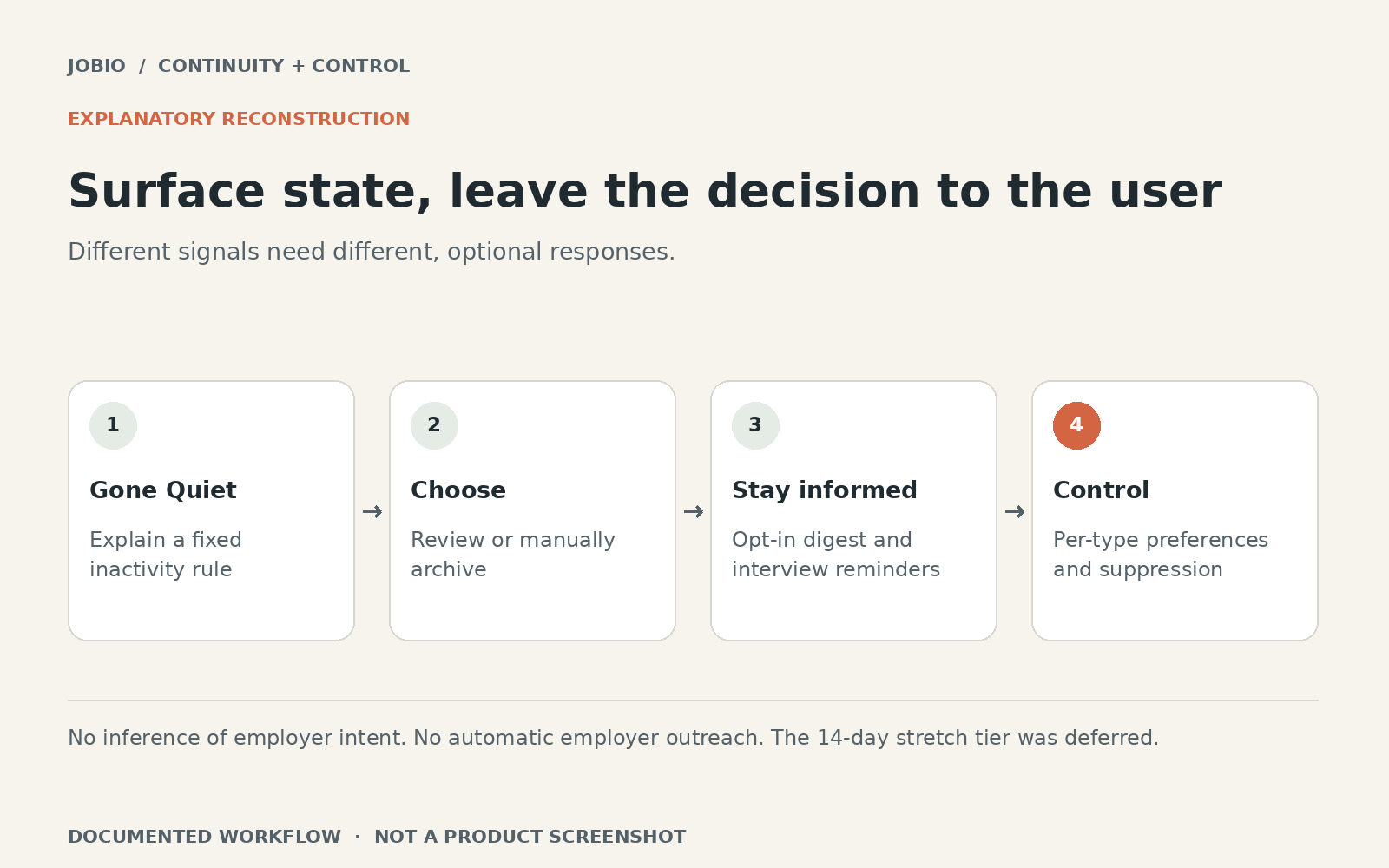
The eventual Gone Quiet requirements document a specific change of direction. The original paid Ghost-Buster concept would generate follow-up or break-up messages. The chosen approach instead used a free, explainable inactivity rule, contextual framing and a manual archive action.
That was a product boundary. Jobio knows when its record last changed; it cannot know why an employer has not replied. Surfacing that recorded state can help the user review the application without making the product speak with unwarranted certainty about another person's intent.
- Alternative considered
The original paid Ghost-Buster concept generating follow-up or break-up messages. The requirements record a decision that this added anxiety/reputational risk and exceeded the useful scope of the feature.
- Deliberate choice
- Use a free, explainable inactivity rule and manual archive action, then add distinct consent-based reminders and digests.
- Accepted trade-off
- A simple rule is limited and may need interpretation; emotional and retention benefits remain hypotheses rather than outcomes.
Giving different reminders different jobs
Later email planning avoided duplicating the in-app silence feature with another silence notification. It instead delivered activity digests, optional interview reminders and distinct stalled-user nudges. Opt-in, per-type preferences and a logged-out preference route made control part of the workflow.
Suppression also mattered. A digest without useful activity should not become an empty message, and repeated workers should not multiply the same send. The implementation paired product-level communication rules with a shared send ledger. A proposed later re-engagement tier was deliberately deferred rather than half implemented.
 Inspect image and full context
What this says about product ownership
The substantive work was choosing a coherent response across in-app and email touchpoints, rather than shipping every brainstormed engagement mechanism. The manual action and preferences keep the user in control of which records to hide and which communications to receive.
Gone Quiet surfaces applications meeting a fixed inactivity rule and offers manual archiving; later opt-in digests, interview reminders and distinct lifecycle nudges extend continuity with preference controls.
An inactivity label does not verify ghosting. Reduced anxiety and improved retention are unmeasured, and the deferred 14-day re-engagement tier is not delivered scope.
I owned the product reasoning, scope and interaction with AI-assisted delivery. The record establishes the selected approach and delivered behaviour. It does not establish reduced anxiety or higher retention, and the inactivity rule remains an interpretation of recorded state rather than proof of ghosting.