Jobio · Product-design decision
From application tracker to preparation copilot
How a tracking MVP became a connected product for understanding a role, preparing an application and following its progress.
Project context: An AI-powered application workspace for understanding roles, preparing documents and tracking a job search. The work spans the application, marketing website, payment model and practical service delivery.
My contribution: Reassess the tracking proposition and maintain the evolving roadmap. Sequence the workspace, CV foundation, role analysis and preparation features. Align the free/paid boundary and public explanation with the resulting workflow.
The first Jobio proposition was practical: keep jobs, employers, contacts and follow-ups together. That foundation solved an organisational problem. It did not help someone interpret a role, decide which experience mattered or turn that understanding into an application.
Reassessing the job to be done
I used a post-MVP reassessment to expand the product question from “How do I keep track?” to “How do I make progress on this application?” The analysis and brainstorms explored role understanding, personal material, outreach and momentum. They supplied hypotheses and options, rather than validated market research.
That distinction mattered to the roadmap. An early proposal favoured inserting reusable snippets into a personal template. The later product generated a complete CV and cover letter from structured career information and saved role analysis. Those were different delivery approaches to the same preparation problem; I did not treat every early proposal as a committed feature.
Giving the direction a delivery sequence
The workspace came before the full preparation experience because generated work needed somewhere to live. Credits established a way to charge for selected model-backed actions. CV ingestion supplied reusable candidate context; role analysis supplied reusable job context. Tailoring and outreach could then use those foundations instead of asking the user to start again.
- Alternative considered
Extend tracking alone, or add AI tools as separate destinations. The reassessment identified preparation tasks that tracking alone did not address; separate tools would still require users to reconnect their context.
- Deliberate choice
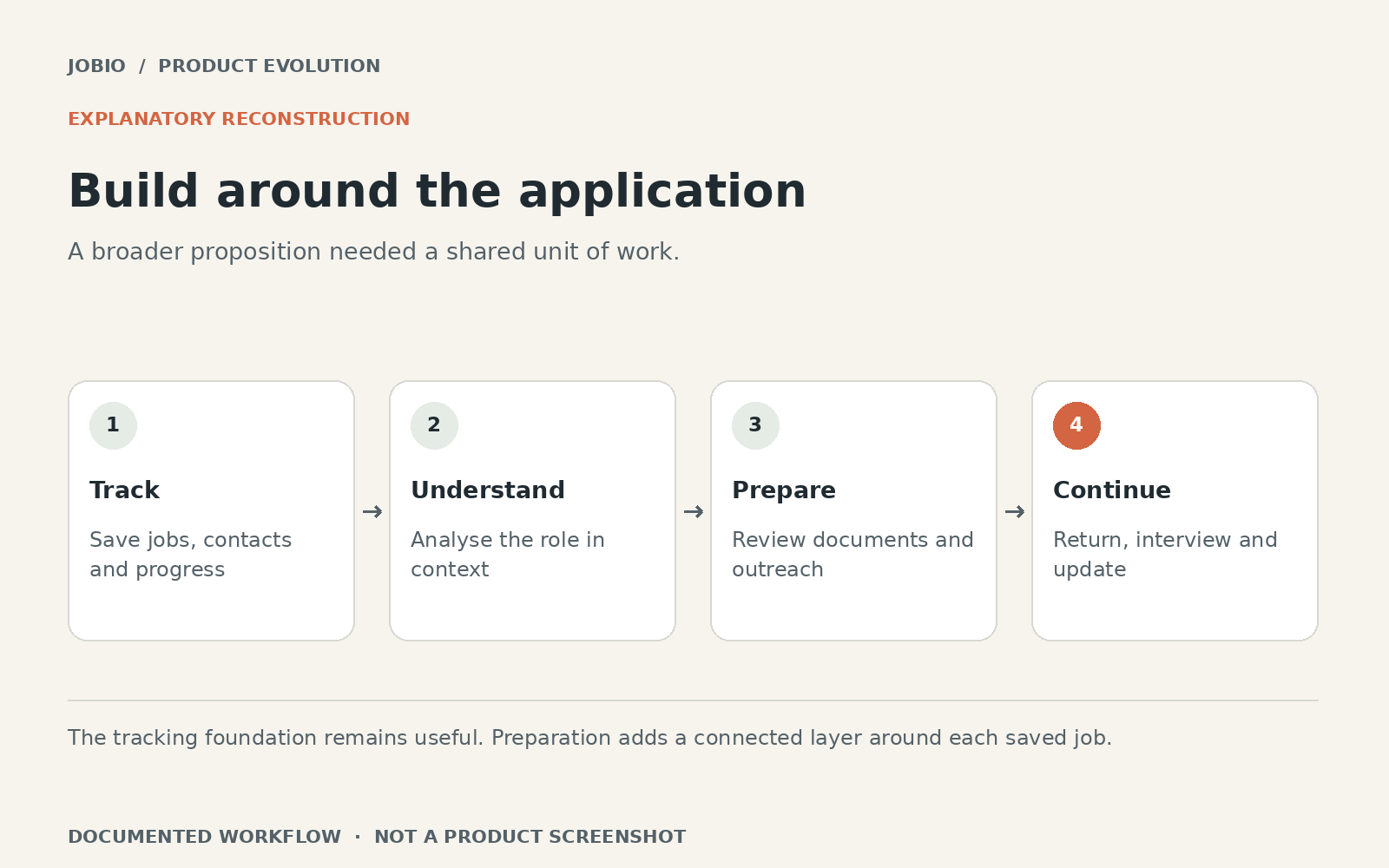
- Keep the saved job as the organising unit and build preparation capabilities around it in stages.
- Accepted trade-off
- A broader proposition creates more prerequisites and a harder first-use journey, so activation needed its own later iteration.
The commercial boundary changed alongside the product. Capture and organisation became free, with credits attached to selected preparation actions. The website also needed to explain preparation rather than keep advertising only a tracker. These were consequences of the direction, rather than separate feature launches with unrelated rationales.
 Inspect image and full context
What this exposed next
The broader proposition made first use more demanding. A new user could still arrive at empty statistics, a CV request or several competing destinations before reaching useful preparation. That became the next journey problem: save one job, reach that saved job and understand the next action.
Jobio evolved from tracking records into a job-centred workflow spanning capture, role analysis, application documents, outreach and progress tracking.
This is delivered product scope and a documented change in direction. It does not establish product-market fit, hiring success or commercial growth.
I owned the product direction, design and delivery with AI assistance. The evidence here is the evolving plan, implementation and release record. It supports a product-ownership account without turning strategy hypotheses into claims of validated demand.