Jobio · Product-design decision
Carrying the first saved job through to useful work
Rebuilding activation around one application, from registration and capture to a clear next action and a return path.
Project context: An AI-powered application workspace for understanding roles, preparing documents and tracking a job search. The work spans the application, marketing website, payment model and practical service delivery.
My contribution: Combine walkthrough diagnosis with exploratory path and replay observations. Reorder first use around Save → Prepare → Track and a saved-job destination. Design recovery, CV-return context, safe cancellation and returning-user continuity.
Jobio's website promised help preparing for an application. First use did not consistently carry that promise into the product: a new account could encounter CV setup, empty statistics or several ways into a long job form.
Diagnosing a journey rather than one screen
I combined a walkthrough of the initial experience with later exploratory path and replay observations. The records showed inconsistent destinations after first-job onboarding and an active user exploring insights without an observed continuation to tailoring. Those observations justified examining the journey; they did not prove confusion or explain every exit.
The design question became concrete: after someone saves one job, can they see what happened and understand what they can do next?
Building a continuous first application
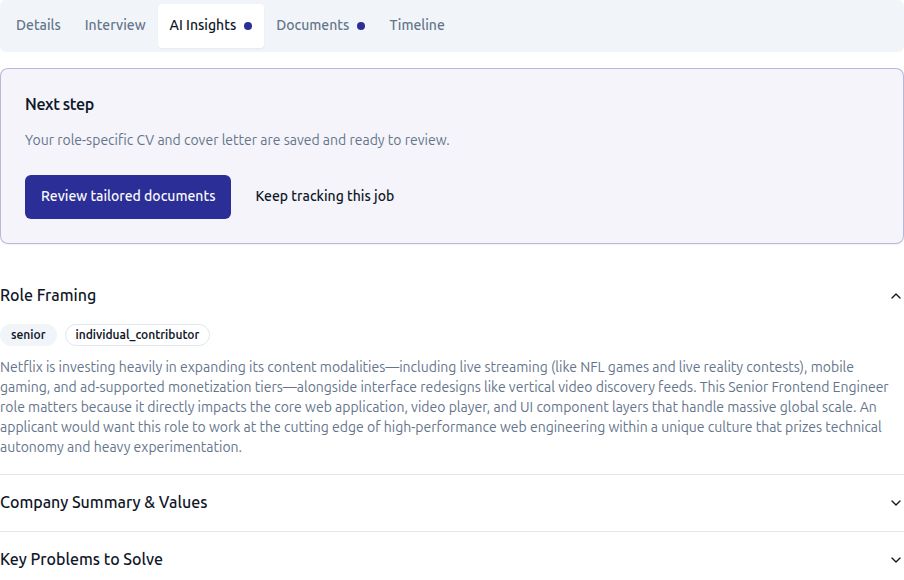
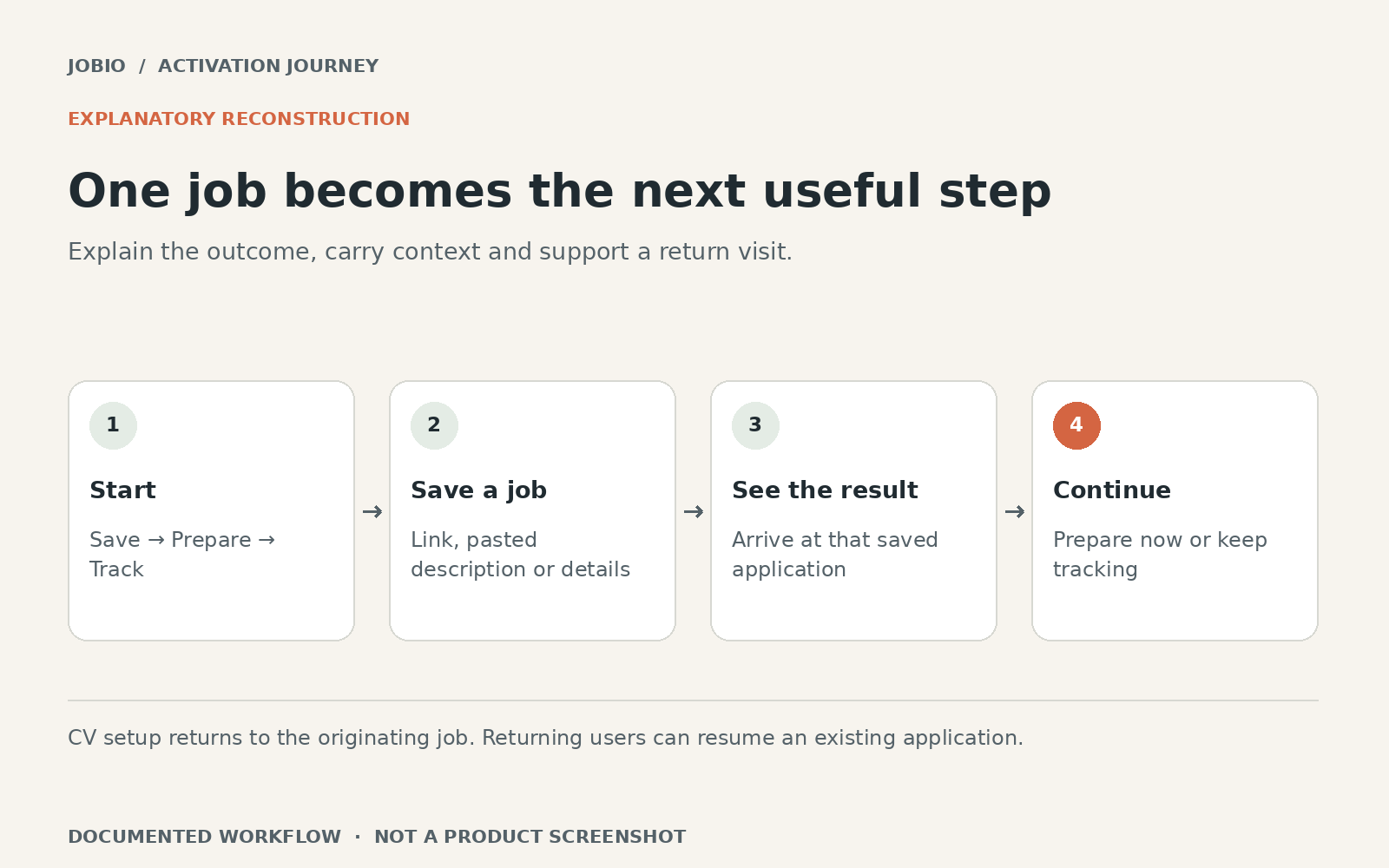
I reordered the explanation around Save → Prepare → Track. The welcome state described the product outcome and gave first-job capture a clear priority. Capture paths converged on the actual saved job, with confirmation that the opportunity had been preserved.
- Alternative considered
Start with CV setup, empty reporting or a generic grid of features. Those entry points introduced prerequisites and navigation choices before the first application had a clear outcome.
- Deliberate choice
- Lead with saving one job, acknowledge the saved result and present one contextual next action.
- Accepted trade-off
- The next action depends on the application and CV state, so the journey needs preserved origin context and a free route to continue tracking.
 Inspect image and full context
This required more than changing a primary button. Failed import needed to retain the source URL and offer pasted-description or basic-entry recovery. Cancelling an edit needed to protect the saved draft. CV setup, when needed for preparation, had to retain the originating job so the user could return to the task that prompted it.
 Inspect image and full context
Making continuation specific
The later workspace guidance selects a relevant next action from the available context, instead of presenting every capability with equal emphasis. A user can prepare a document when ready or continue tracking without paying for preparation. Returning users also need continuity, so the Dashboard can resume work on a current job rather than lead with a generic feature grid.
Together these changes form an activation story across entry, capture, result, prerequisite and return. Individual notices, cancellation fixes and CTA changes are supporting decisions within that journey.
The revised first-use journey explains Save → Prepare → Track, carries capture into the saved job, preserves recovery input and connects preparation or continued tracking to a contextual next step.
Recorded paths and replays informed the changes but do not prove why users stopped or establish a conversion improvement.
My contribution combined product diagnosis, interaction design, copy, prioritisation and AI-assisted delivery. The result is a more continuous implemented flow. The available evidence does not support a numerical activation gain or a causal claim about user behaviour.