Jobio · Product-design decision
Letting the application differ from the default
Extending a locally opinionated CV workflow with saved preferences, per-run overrides and consistent exports.
Project context: An AI-powered application workspace for understanding roles, preparing documents and tracking a job search. The work spans the application, marketing website, payment model and practical service delivery.
My contribution: Separate saved defaults from application-specific document choices. Carry resolved preferences through prompts, saved sessions and exports. Define safe language suggestion and explicit font, scoring and interface limits.
The original preparation instructions were opinionated: English oriented to the NZ/AU context, a particular tone and assumptions about document length and optimisation. Those defaults were useful starting points, but a user may apply to a different market or need a different style for one role.
Designing two levels of preference
I separated a user's usual defaults from the choices for a particular tailoring run. Settings can hold document language, English spelling, tone, length and optimisation preferences. The preparation flow can override them for one application without silently changing what happens next time.
The job description can suggest a supported language, but that suggestion is limited. It does not establish the employer's country, preferred English spelling or broader document conventions. The user remains able to see and change the effective choices.
- Alternative considered
Keep fixed NZ/AU-oriented assumptions or let each run overwrite the user’s defaults. Fixed assumptions limit useful document variation; implicit default changes make later output unpredictable.
- Deliberate choice
- Resolve per-run choices over saved defaults, snapshot the resolved values with the session and keep language suggestions explicit.
- Accepted trade-off
- A bounded supported-language set and export/scoring limits need explanation; this does not become a fully localised application.
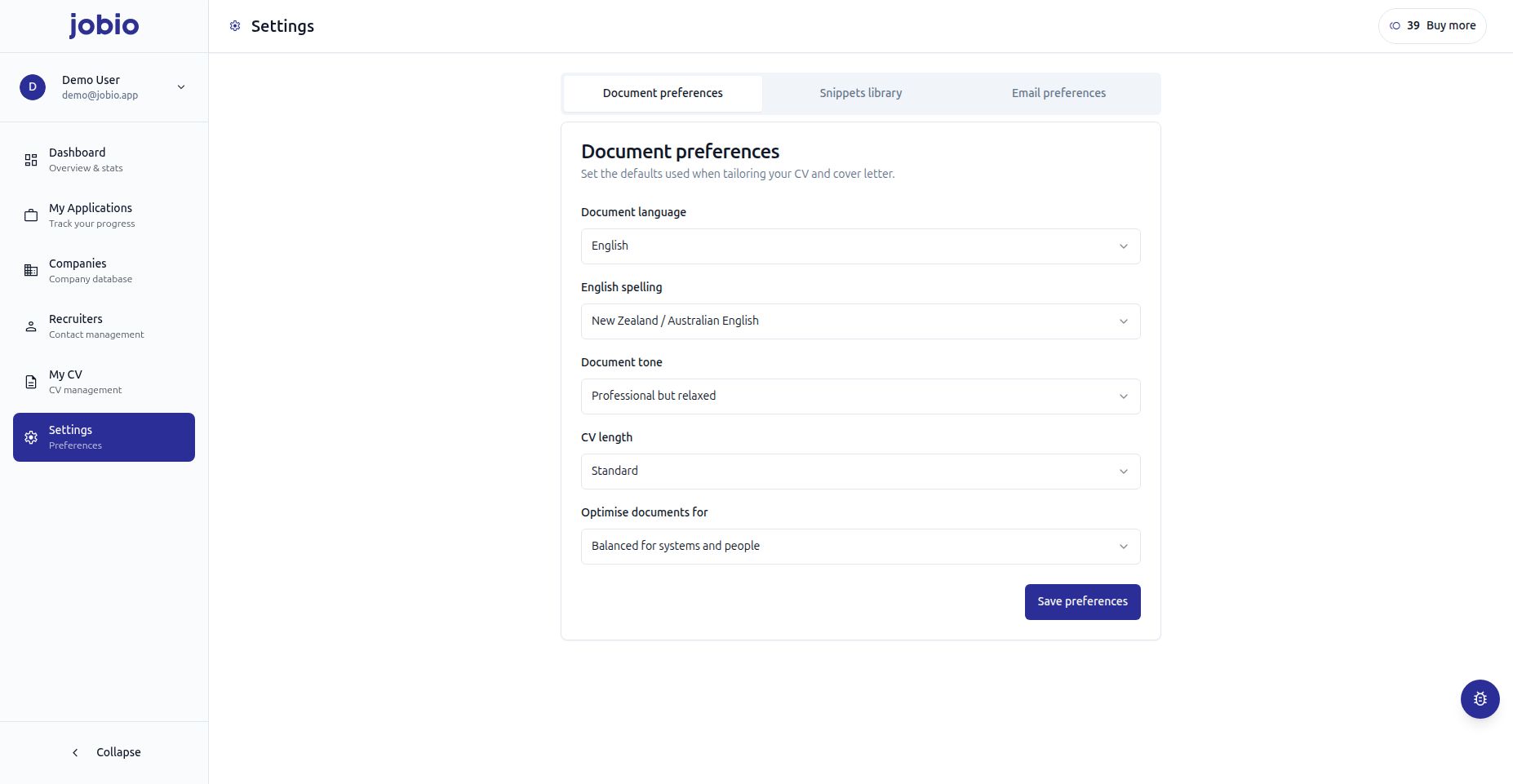 Inspect image and full context
Carrying the choice through the whole output
A dropdown is only the start of this feature. The server resolves and validates the chosen values before building the prompt. The saved session retains a snapshot of the effective preferences, so revisiting a result does not depend on whatever the user's defaults happen to be later.
Exports use appropriate headings and date locales for supported document languages. Existing users retain the prior default behaviour unless they make a different choice. These details connect personalisation to backwards compatibility and reproducibility, rather than treating it as decorative configuration.
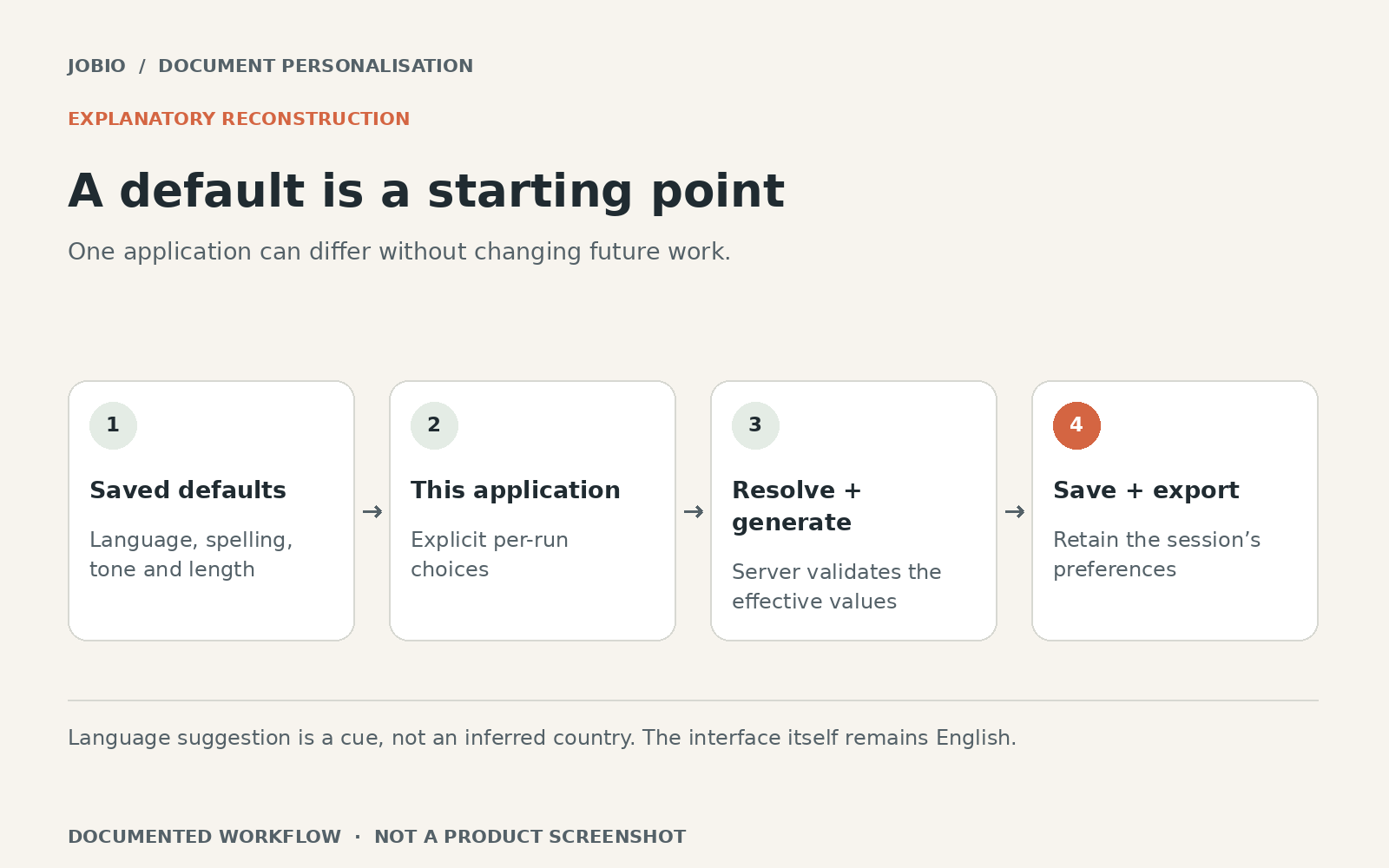 Inspect image and full context
Keeping the scope credible
The feature uses a bounded language set compatible with the export font coverage. Length remains approximate, and English-oriented assessment has limits for other languages. The application interface stays in English, so document personalisation is distinct from a complete internationalisation or localisation programme.
Document language, English spelling, tone, length and optimisation preferences can be saved, overridden for one run and retained with the generated session and locale-aware export labels.
This is bounded document personalisation. The interface remains English; approximate length, PDF script coverage and English-oriented scoring limit the result, with no native-language quality or adoption uplift established.
I owned the preference model and end-to-end experience with AI-assisted implementation. The result establishes concrete personalisation and document-generation work. It does not establish native-language editorial quality, an international launch result or a measured change in adoption.