Jobio · Product-design decision
Turning a seven-step AI workflow into a product
Designing the complete journey from career information and a target role to reviewed, saved and exportable application documents.
Project context: An AI-powered application workspace for understanding roles, preparing documents and tracking a job search. The work spans the application, marketing website, payment model and practical service delivery.
My contribution: Translate the preserved manual preparation process into a product workflow. Design CV input, role context, generation, review, editing and export. Connect model stages, saved sessions, preferences and failure recovery with AI-assisted implementation.
Jobio's preparation proposition depends on LLMs. The design work was therefore about the complete AI-powered task: what the model needs, what the user sees, how they steer the result and what remains useful when something fails.
Starting with an existing preparation process
The project record preserves a seven-step manual process: understand the company, connect the candidate's background, infer the problems behind the hire, identify relevant language, prepare a CV, write a cover letter and assess the result. Repeating that process meant copying career material and role information between prompts.
I translated those dependencies into reusable product context. Users could add a CV through file, text or manual entry, review its structured interpretation and correct it. A saved job could hold its own role analysis. Tailoring could then combine those two sources instead of asking for everything again.
Designing the work around the model
The preparation experience needed to communicate prerequisites and credit cost before generation, show processing and failure states, and give the user a way to review, edit, save and export the result. The model's response was a draft to work with, rather than a document the product could certify as correct.
- Alternative considered
Treat generation and assessment as one all-or-nothing response. Failure in the assessment stage would discard useful document work and make recovery less predictable.
- Deliberate choice
- Build reusable CV and role context, then separate document generation from the subsequent assessment.
- Accepted trade-off
- The journey needs prerequisites, explicit processing states, saved-session behaviour and user review rather than a single instant-answer promise.
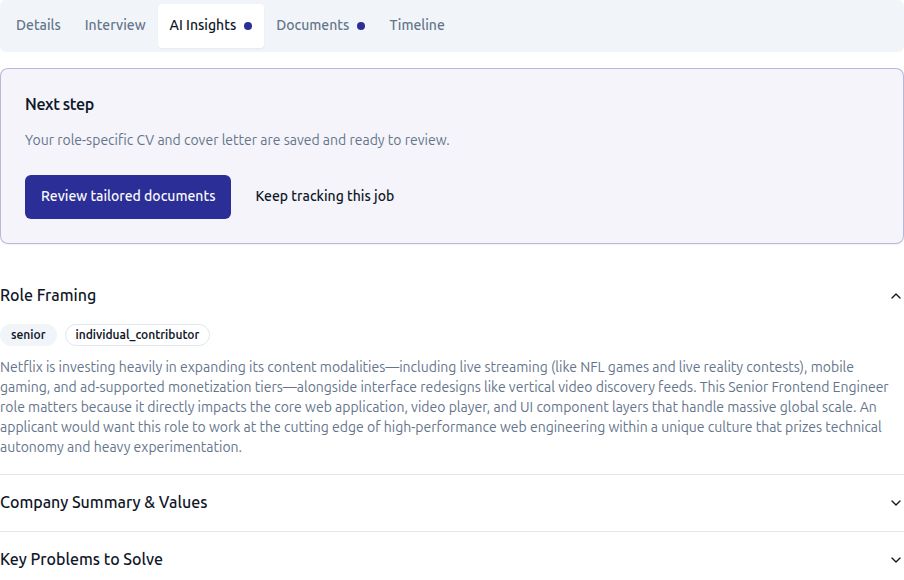 Inspect image and full context
Generation and assessment became separate stages. The service validates generated structure, attempts a later assessment and keeps the documents usable if that assessment fails. This creates a more useful recovery boundary than treating the entire application package as one successful-or-failed answer.
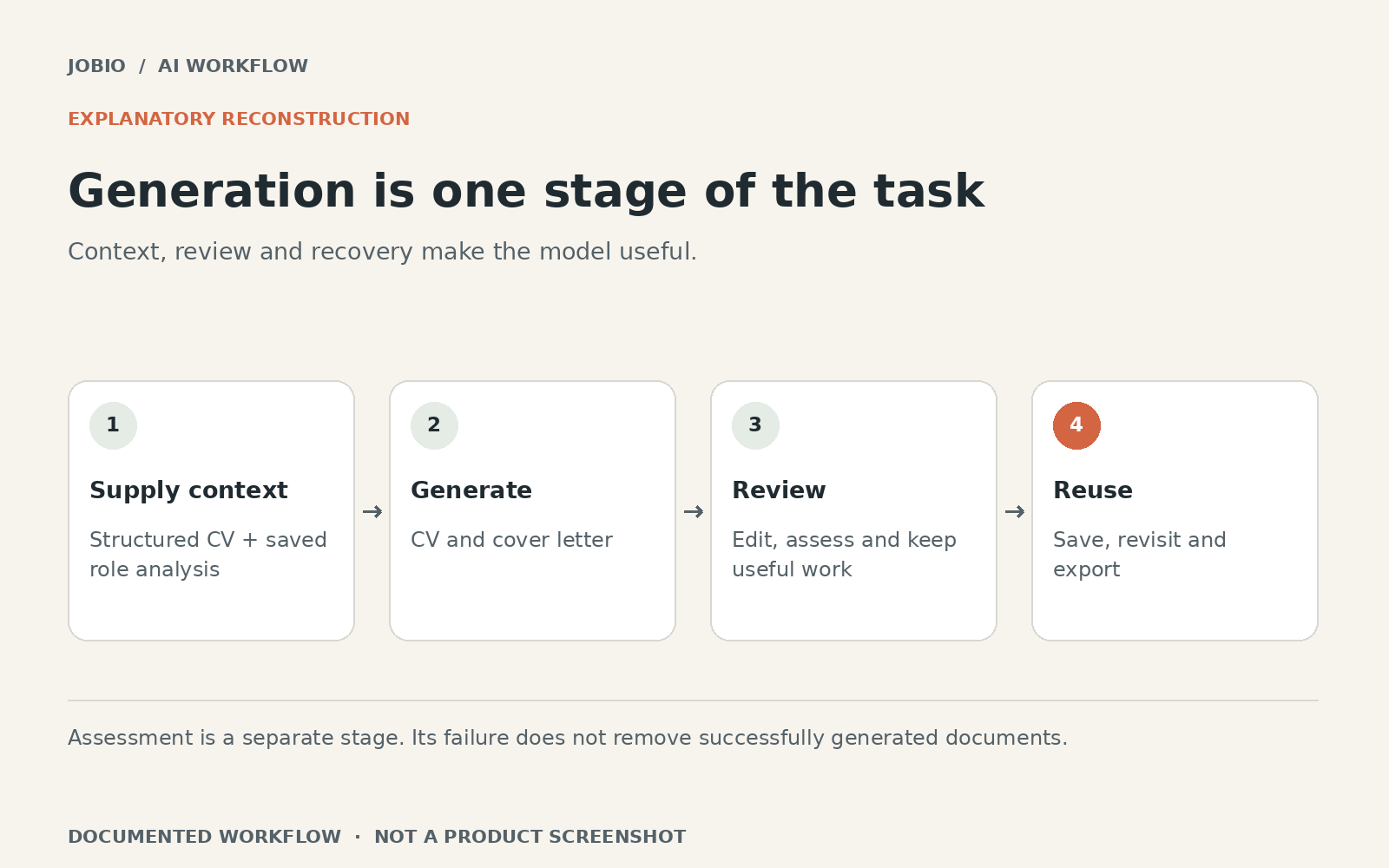 Inspect image and full context
Generalising the personal workflow
Later work gave users more control over context and output. A deliberately small, user-curated snippet library supplied additional achievements without automatically accumulating every generated variant. Saved document preferences and per-run overrides let an application differ from the user's usual defaults. Saved sessions made previous work available for return visits.
These additions extended one workflow rather than producing another chatbot destination. The job remained the context; the user remained responsible for reviewing the material and submitting an application outside Jobio.
The implemented workflow connects structured CV and role context to generated CVs and cover letters, review/edit controls, saved results and exports; documents remain usable when the later assessment fails.
The account demonstrates AI product design and practical LLM orchestration. Generated assessments do not prove ATS acceptance, factual accuracy or better employment outcomes.
I designed and built the product with AI assistance. That development method is separate from the AI product-design work and the LLM integration behind it. The evidence supports all three at a practical product level; it does not imply model training or guaranteed document quality.